Our kids are growing up in a world where real-life engagement is too often replaced by algorithms, passive consumption, and outsourced thinking. Speech and debate offers something different: a chance for students to think for themselves, speak up when it matters, and engage others with empathy. Over time, that is how we help build a more thoughtful Los Angeles.
We believe this begins with Middle School Speech & Debate.
Scroll through the page to learn more about our league, or click a button to jump directly to a section.
The Vision of Middle School Debate in Every Neighborood
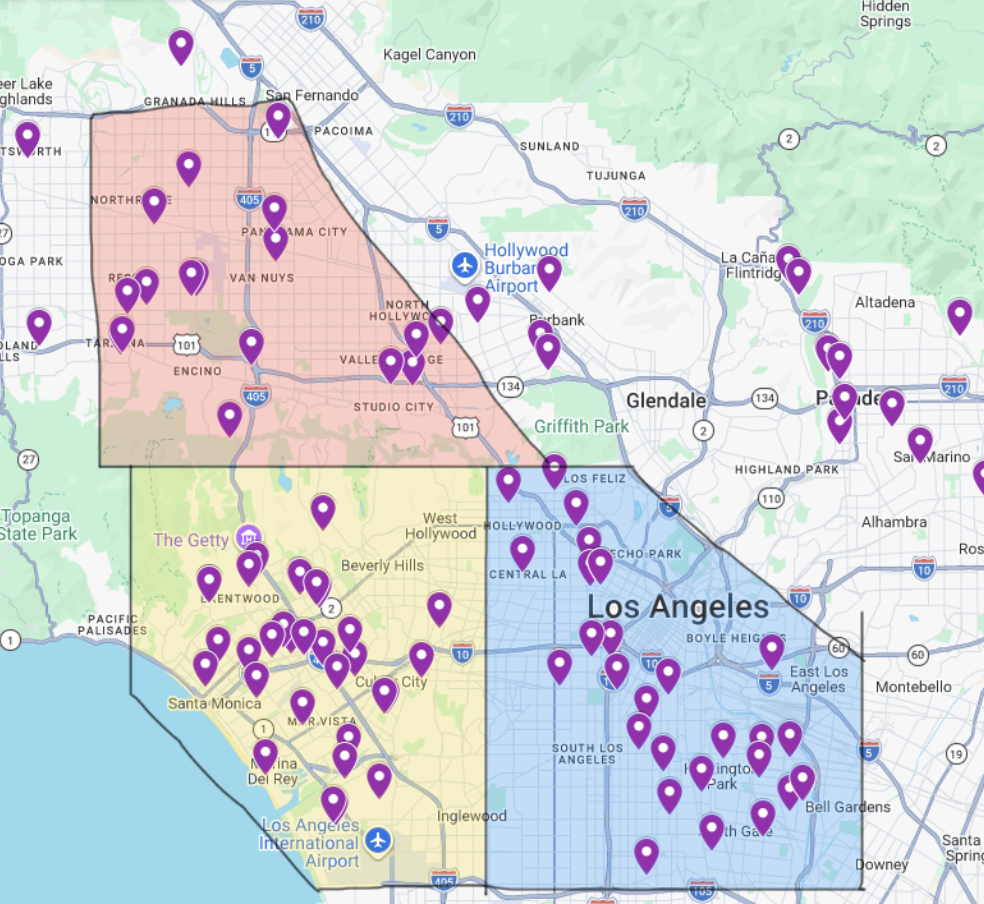
Our league becomes more manageable as more nearby schools join. Greater Los Angeles has well over a thousand schools that serve grades 6–8, which gives us the opportunity to build small, tightly clustered regional leagues across the city. As those local clusters grow, travel gets shorter, hosting gets easier, and weeknight debate starts to fit the same rhythm, and become even more routine a typical middle school athletic sport.
We hope each founding school will help us identify a few nearby schools that may also be a fit. With a small local cluster in place, we can begin building a season close to home.
What Schools Need To know
Below we try to provide fuller picture about the logistics of how the league is designed to work within the rhythms of school life, and what participation can make possible for students and schools across Los Angeles.
A predictable season and meet schedule that make League Logistics Easy
Joining the league is designed to be straightforward for schools. Each school designates one teacher or advisor to recruit students, supervise weekly practice, attend meets, and serve as the school’s point of contact. The league provides the competitive structure, schedule, and support that make participation manageable for educators without prior speech and debate experience. Schools can expect a clear season schedule, after-school (or occasional Saturday) meets of about two hours, transparent participation costs, and a level of commitment that can fit the busy lives of teachers & families.
-
The ideal advisor is an educator or staff member who is organized, enthusiastic about student growth, and willing to show up consistently for students. The most important qualities are reliability and a genuine interest in helping students develop confidence and communication skills.
-
No. We provide centralized coaching on the topic, a shared league packet with research and preparation materials, and practical guidance for running practices and attending meets. The advisor’s role is to be the on-campus point person: supporting students, getting them to meets, and communicating with families and school administrators. We handle the content and preparation.
Certainly, if the advisor wants to do more with coaching, we can help them reach those goals, too.
-
The league is designed to be accessible. There are no league fees, no requirement to hire outside coaching, and no significant outside investment required from families. Schools should plan on compensating the advisor/coach for their time and covering any transportation and after-school facility costs such as janitorial services.
-
The regular season runs from January through March and includes six to eight meets. Meets are held after school or on Saturdays on a schedule built to be compatible with the school calendar.
-
The regular season runs from January through March and includes six to eight meets. Meets are held after school or on Saturdays on a schedule built to be compatible with the school calendar.
-
Schools receive a centralized topic packet with research and preparation materials for students and advisors, practical support for running practices and preparing for meets, full league scheduling and meet coordination, and access to NSDA coaching resources including videos, lesson plans, and event guides. Fall training and kickoff events with the NSDA help build community and get teams ready before the season begins.
-
Schools designate an advisor, provide a weekly practice time, bring students to league meets, and host one meet during the season. That is the full scope of the school’s commitment. Everything else is handled by the league.
-
Yes, each participating school hosts one after-school or Saturday meet during the season. We provide the structure, scheduling support, and coordination to make hosting straightforward. Meets are designed to run about two to two and a half hours, keeping the commitment manageable for your campus.
Simplified Speech and Debate Formats Accessible to Students & Educators without Experience
Our events are middle-school adaptations of established speech and debate formats. They are designed so that coaches do not need prior speech and debate experience; instead, the league emphasizes the core skills of advocacy, reasoning, organization, and public speaking in ways that are straightforward to teach and easy to understand.
-
World Schools Debate is a 3-vs-3 team debate format. We chose it because it gives students the chance to research and prepare in advance while also requiring them to listen, adapt, and respond in real time. Each team has three speakers, all of whom give one substantive speech, followed by a short reply speech from one speaker on each side.
Round Format
Proposition 1 — 4 minutes
Opposition 1 — 4 minutes
Proposition 2 — 4 minutes
Opposition 2 — 4 minutes
Proposition 3 — 4 minutes
Opposition 3 — 4 minutes
Opposition Reply — 2 minutes
Proposition Reply — 2 minutes -
Original Oratory is a prepared speech event in which students research an issue, develop a clear and specific advocacy, and deliver their own speech. Students are judged on presentation, clarity of argument, and the effectiveness with which they communicate a proposed solution.
In each round, 3–6 students deliver their speeches and are ranked by the judge based on presentation, clarity of argument, and how effectively they communicate a solution to the issue they have chosen.
-
Each season is organized around a single topic area. All debate motions for the season are drawn from that topic, and Original Oratories ask students to address issues related to the same area of focus.
This structure makes preparation more manageable for coaches and students, while also allowing them to develop a deeper understanding of the subject over time. Rather than skimming a series of unrelated issues, students can move beyond superficial facts and engage the topic with greater depth, clarity, and confidence.
-
Possible season topics are chosen for their relevance to middle school students and their ability to support meaningful speech and debate across an entire season. The strongest topics are broad enough to sustain multiple rounds and speeches, but focused enough to reward deeper preparation over time.
Technology & Social Media: Students are growing up fully immersed in these systems and experience both their benefits and harms in everyday life.
Education & School Policy: Because students encounter school rules, expectations, and disciplinary systems every day, they often have immediate and thoughtful perspectives on fairness, workload, and authority.
Environment & Climate: Many students are already thinking seriously about environmental change, personal responsibility, and the relationship between individual choices and systemic action.
Privacy & Independence: Middle school is an age when students are beginning to seek greater autonomy while adults remain focused on safety, boundaries, and guidance.
Community & Belonging: Questions about inclusion, fairness, identity, and mutual responsibility are especially resonant at a stage when social belonging matters deeply.
-
Based on The Season Topic Areas, here are some potential motions:
Technology & Social Media
"Schools should be allowed to monitor students' social media accounts to prevent cyberbullying."
Education & School Policy
"Standardized testing should be replaced with student portfolios for measuring achievement."
Environment & Climate
"Schools should be required to serve only plant-based lunches to reduce environmental impact."
Privacy & Independence
"Schools should be allowed to search students' lockers and backpacks without permission to keep everyone safe." -
Technology & Social Media
“Seen but Not Heard”
What happens when your whole life is posted online before you’re old enough to consent. A speech about children’s digital footprints and the right to grow up without an audience.
Education & School Policy
“The Homework Trap”
How after-school assignments affect students differently based on their home lives, and why the homework conversation debate is really a conversation about fairness.Environment & Climate
“When Green Isn’t Fair”
Why environmental solutions sometimes hurt the people who can least afford it, and how we can fight for a planet and for people at the same time.Privacy & Independence
“The Longest Leash”
How tracking apps and constant monitoring changed the relationship between parents and kids, and what trust looks like in the digital age. -
Rounds are judged by trained community volunteers. We provide judge training for anyone willing to serve, so no prior speech and debate experience is required. We are actively building a judge pool in partnership with local colleges, law firms, and other community members who want to invest in student development across Los Angeles.
League Leadership and Our Partners
The organizations and people behind the league: the national institutions, local partners, and on-the-ground leadership working together to make this opportunity real for schools and students.
-
The National Speech and Debate Association is the largest interscholastic speech and debate organization in the United States, connecting, supporting, and inspiring a diverse community committed to empowering students through speech and debate. Founded in 1925, the NSDA has spent a century setting the national standard for the activity and building the infrastructure that allows programs to start, grow, and sustain themselves. Schools that join the LA Middle School League become NSDA members, giving students access to a nationally recognized honor society, earning points toward recognition for sustained participation and achievement, and connecting to a broader national community of schools, students, and educators. The NSDA is not a passive credentialing body: it provides coaches with videos, lesson plans, event guides, and direct mentorship, and it sponsors Team USA in World Schools Debate, the international competition format this league uses.
Learn more at: https://www.speechanddebate.org -
Debate Matters is a local organization founded on the belief that access to debate and debate coaching should be easier to find for schools and families.
Debate Matters leads the LA Middle School Speech and Debate League, built and run by two lifelong debate educators with decades of experience growing programs across Los Angeles and the country.
Mike Bietz brings nearly 30 years of program-building experience to this league. He has served in leadership roles across the activity, including the Tournament of Champions Advisory Committee, the Los Angeles Metropolitan Debate League, and as president of the National Debate Coaches Association. His work has earned Coach of the Year recognition, induction into the Emory University Key Coach Society, the USC Trojan Debate Squad Community Service Award, and induction into the Tournament of Champions Coach Hall of Fame as its first Asian-American and first Southern Californian member.

Chris Theis is the Executive Director of Victory Briefs, one of the country’s most influential debate organizations, and has spent his career building coaching resources and curriculum used by programs nationwide. He has served in leadership roles with the Tournament of Champions, NSDA, and the National Debate Coaches Association.
Learn more at: https://debatematters.org -
The Los Angeles Metropolitan Debate League is the city’s established high school debate league and a direct partner of this middle school program. LAMDL currently serves 30 participating Los Angeles high schools, providing free debate opportunities and summer programming for students, and is a member of the National Association of Urban Debate Leagues. The league has a documented record of student impact: LAMDL graduates currently hold debate scholarships at USC, Cal State Fullerton, Cal State Northridge, and Cal State Long Beach, and recent alumni have continued competing at Harvard, Berkeley, Northwestern, and other leading universities. For middle school students who join this league, LAMDL represents a potential next step, a proven local pathway into high school debate with an institutional track record behind it.
Learn more at: https://www.lamdl.org/ -
This league is part of something larger. The NSDA is making a sustained, institutional investment in Southern California through the launch of a California Regional Partnership Office, a dedicated local infrastructure effort focused on recruiting schools, supporting coaches, and building long-term debate access across the region. The goal is not a single season. The NSDA’s five-year national plan aims to double the number of schools and students participating in speech and debate, from 4,000 schools and 100,000 students today to 8,000 schools and 200,000 students, with a long-term vision of a speech and debate program in every school in the country. Los Angeles is a priority market in that plan. The NSDA is seeking $1 million in two-year commitments to launch and sustain the Southern California Regional Partnership Office, reflecting a level of investment that signals this is a long-term commitment to the region, not a pilot program. Schools that join the LA Middle School League are not signing up with a startup. They are joining the ground floor of a nationally backed, locally rooted effort to make speech and debate a permanent fixture of public education in Los Angeles.
To learn more about this initiative, please reach out to Alan Coverstone, Director of Regional Partnerships at The National Speech and Debate Association: alan.coverstone@speechanddebate.org.
The Case for Speech and Debate
This section is designed to help supporters explain why speech and debate matters and why schools should offer it. It gathers the clearest arguments for parents, principals, educators, and advocates who want to make the case to school leaders, boards, colleagues, or families that this is a meaningful opportunity worth bringing to students.
-
We are raising a generation of students in a world that increasingly rewards passive consumption over active thought. At a time in their lives when kids should be learning how to think, analyze, discover, and build their character, we are in a world where algorithms decide what to see, AI shortcuts replace reasoning, and social platforms model reaction over reflection. Speech and debate is the structural antidote.
It is one of the few school-based activities that simultaneously builds critical thinking, public speaking, reading for purpose, listening, and civic engagement woven together in a single competitive format. Students learn to defend their ideas, under pressure, in front of real people. Speech and debate turns academic skills into lived habits.
In a moment when schools are searching for structures that help students think independently and engage others with empathy, speech and debate belongs at the center of a student’s education. Not on the margins. -
Most activities develop one or two skills at a time. Speech and debate uniquely combines reading, critical thinking, public speaking, listening, and healthy competition into one structure. Students leave each season measurably stronger than when they started.
The skills students build:
Critical thinking under pressure. In debate, students build arguments from evidence, anticipate opposing views, and respond in real time. There is no script to fall back on.
Public speaking and presence. In Original Oratory, students write, prepare, and deliver their own speeches, developing confidence, clarity, and voice.
Evidence-based reading. Speech and debate transforms reading from a compliance exercise into purposeful preparation. Students read to compare claims, weigh sources, and build arguments, all in service of making a real case to a real audience.
Intellectual confidence. Students learn to trust their own judgment, hold their ground when challenged, and stay composed under pressure. That confidence becomes a form of protection: students who know how to think for themselves are harder to manipulate, mislead, or pressure.
Respectful disagreement. Students practice hearing opposing views without treating disagreement as a threat. They learn to respond with reasons and evidence rather than interruption or outrage, a skill in short supply right now.
Research from the Los Angeles Metropolitan Debate League shows that speech and debate alumni demonstrate higher self-esteem, increased school attendance, sharper analytical skills, and strong college acceptance rates.
-
Schools that offer speech and debate send a clear signal to students, families, and the broader community: this school believes in rigorous academic opportunity beyond the regular school day.
Speech and debate strengthens your school in four concrete ways:
Academic outcomes. Students who participate develop stronger reading, writing, research, and reasoning skills that carry over into all their coursework.
School culture. Speech and debate builds a culture of intellectual confidence and respectful engagement. Students who learn to argue well and listen carefully bring those habits into classrooms and hallways.
Community and distinction. Families choosing schools notice programs that signal ambition, rigor, and student growth. Speech and debate is one of the most visible markers of a school that invests in students as thinkers and advocates.
Free NSDA membership. Every school that provides a staff or faculty coach/advisor joins the National Speech & Debate Association, the largest interscholastic speech and debate organization in the United States. Schools gain access to a national community of educators, curriculum resources, coaching support, and a nationally recognized honor society for students.
The league is designed to be manageable. Schools provide an advisor/coach, a weekly practice time, attendance at league competitions, and one hosted meet. We provide the structure, topic materials, scheduling, and coaching support.
-
Middle school is a narrow and critical window. Students are forming their first real beliefs about their own voice: whether they have ideas worth sharing, whether people will take them seriously, and whether speaking up is worth the risk. Once those beliefs solidify, they are hard to change.
By high school, many students have already committed to other activities and identities. They are less likely to try something new and more likely to feel that the window for this kind of discovery has passed. That means the chance to shape a student’s relationship with public speaking, advocacy, and intellectual confidence is often lost before high school begins.
Too often, access to speech and debate in middle school depends on private schools or private programs. Students in public schools, who arguably need these skills most, are frequently left out of the opportunity altogether. This league exists to change that. Every student deserves the chance to discover their voice early enough for it to matter, and in school, not outside of it.
-
Families want to know their children are building skills that last. Speech and debate delivers on that promise in ways that most school programs do not, and this league format is specifically designed to make participation realistic for real families.
What families gain:
Visible academic growth. Parents see their children become more confident, more articulate, and more willing to engage in hard conversations. These are not abstract outcomes. They show up at the dinner table.
A structured, school-based activity. This league lives inside the school, unlike private programs or club teams that require significant outside investment. There are no costly private coaches, no separate program fees, and no requirement to seek out opportunities on your own.
A predictable season. The league runs on a sports-season model families already understand: fall preparation, a January through March regular season, and an April championship. Families can plan around it.
A pathway that extends well beyond middle school. Participation gives students a direct on-ramp into high school speech and debate, NSDA Honor Society recognition, and for students who love it, a pathway all the way through high school and on to college and international competition.
The right moment. Families who want their child to find their voice, build confidence, and learn to engage the world thoughtfully have one window that matters most: middle school. This league is built for exactly that window.
Supporting the League
Individuals and organizations can help strengthen the league and expand access for more students. Whether through advocacy, volunteering, partnership, sponsorship, or philanthropy, support from the broader community can help more schools offer speech and debate and help more students participate.
-
Financial contributions to the LA Middle School Speech and Debate League are made through the National Speech and Debate Association, a 501(c)(3) nonprofit organization, making every gift fully tax-deductible. The NSDA connects, supports, and inspires a diverse community committed to empowering students through speech and debate, and envisions a world in which every school offers programs that foster communication, critical thinking, collaboration, and creative skills. Gifts at any level help fund training materials, coaching support, and program infrastructure that make it possible for more Los Angeles students to participate. To make a contribution, visit speechanddebate.org/donate or contact us directly to discuss sponsorship and partnership opportunities.
-
Judges are the backbone of every meet. We provide full training for anyone willing to serve, so no prior speech and debate experience is required. If you work in law, education, communications, public policy, or any field that values clear thinking and persuasive communication, you are exactly the kind of judge our students benefit from. Community members, college students, alumni, and professionals are all welcome. To sign up or learn more about judge training, contact us.
-
One of the most powerful things you can do for this league is help us reach the right schools. If you know a principal, assistant principal, or school administrator who believes in expanding academic opportunity for students, we would welcome an introduction. Schools that join the league gain a structured, low-commitment program that builds student confidence, critical thinking, and civic engagement. Word of mouth from trusted community members opens doors that cold outreach cannot.
-
One of the most powerful things you can do for this league is help us reach the right schools. If you know a principal, assistant principal, or school administrator who believes in expanding academic opportunity for students, we would welcome an introduction. Schools that join the league gain a structured, low-commitment program that builds student confidence, critical thinking, and civic engagement. Word of mouth from trusted community members opens doors that cold outreach cannot.
Frequently Asked Questions
We address some of the most common questions schools, families, and supporters may have about the league. This section is meant to clarify practical concerns, answer points of comparison with other activities, and help interested schools better understand whether the league is a good fit for their students and community.
-
Model UN is a valuable activity, and students who love it often thrive in speech and debate as well. Model UN develops real skills around diplomacy and collaborative problem-solving within an international relations context. Speech and debate broadens that foundation: students learn to construct arguments from evidence, think on their feet, and communicate clearly to any audience on any topic. The two activities develop students in different and complementary ways, and many students participate in both.
-
Mock Trial is a strong program, and we are glad when schools offer it. But Mock Trial is training students for one specific context: a courtroom. The preparation, the format, and the skills are all oriented around legal procedure and advocacy. Speech and debate builds something fundamentally broader. Students learn to research any topic, argue any position, speak to any audience, and think under pressure in formats that reflect the real range of situations they will face in school, work, and civic life.
Speech and debate also reaches a much wider range of students. It does not self-select for students who are already drawn to law or competition. It has a way of surprising students who never imagined themselves as strong speakers or thinkers, and that is part of what makes it worth offering alongside anything else a school already does. -
That is great news. Prior experience means your students and advisor already understand the value of the activity. This league is designed to work alongside existing programs, not replace them. If your school competes in another league, joining this one expands your students’ opportunities, connects them to the NSDA and its Honor Society, and adds a season structure built specifically for the Los Angeles middle school community. Reach out and we can talk through how participation would fit with what you are already doing.
REACH OUT
Fill out the form below and we’ll respond within a couple of business days to discuss your goals, timeline, and next steps.